HYDROGEN UKRAINE
JOIN THE
FUTURE




More than 60 Hydrogen Valleys
PROJECTS
Hydrogen Valley is a localized ecosystem fostering the production, distribution, and utilization of hydrogen as a clean energy source. It brings together industry, research, and communities to advance hydrogen technologies, infrastructure, and applications, driving the transition to a sustainable energy future.
There are more than 60 Hydrogen Valleys spanning in Europe were defined.
PROJECTS
More than 60 Hydrogen Valleys
Hydrogen Valley is a localized ecosystem fostering the production, distribution, and utilization of hydrogen as a clean energy source. It brings together industry, research, and communities to advance hydrogen technologies, infrastructure, and applications, driving the transition to a sustainable energy future.
There are more than 60 Hydrogen Valleys spanning in Europe were defined.

PROJECTS
Lead developer
Hydrogen Ukraine LLC
Location
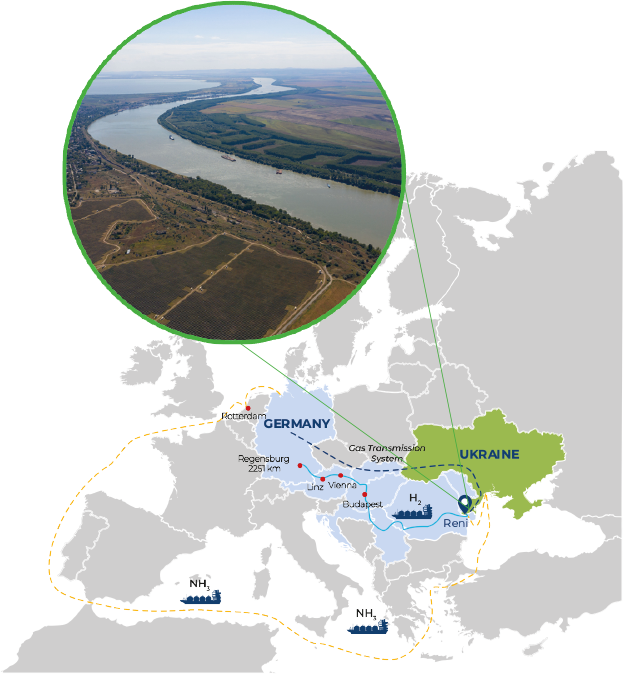
Reni, Odesa region, Ukraine
Description
Constructing a renewable hydrogen plant aiming for an initial electrolysis capacity of 100 MW, dedicated to producing renewable electricity and green hydrogen for domestic needs and export to EU countries
Advantages
Abundant water resources, optimal PV and wind power configuration H2 production is strategically located near the EU border
Scalability
100 MW of electrolysis by 2028
200 MW electrolysis by 2030

Electrolyser capacity: 100MW
Solar: 120MW
Wind: 80MW
Period of construction: 24 months
Supported by
Lead developer
Hydrogen Ukraine LLC
Location
Reni, Odesa region, Ukraine
Description
Constructing a renewable hydrogen plant aiming for an initial electrolysis capacity of 100 MW, dedicated to producing renewable electricity and green hydrogen for domestic needs and export to EU countries
Advantages
Abundant water resources, optimal PV and wind power configuration H2 production is strategically located near the EU border
Scalability
100 MW of electrolysis by 2028
200 MW electrolysis by 2030
Electrolyser capacity: 100MW
Solar: 120MW
Wind: 80MW
Period of construction: 24 months
Supported by

Prepared by the Ludwig-Bölkow-Systemtechnik GmbH, the study assesses the viability of establishing a power-to-hydrogen (PtH2) plant in the region, including renewable potentials, technical aspects, and economic feasibility. The considered plant capacities have an installed electrolyser electricity input capacity of 100, 200, and 3,000 MW. The near-term export of hydrogen is planned to be implemented by using ISO containers for LOHC, liquid hydrogen, or compressed gaseous hydrogen on transport barges up the Danube River and by the pipeline.
A Front-End Engineering Design (FEED) study was prepared by JSC “Institute of Oil Transportation“.
The Institute of Geological Sciences of NAS of Ukraine, conducted a thorough examination of surface and groundwater in the region. The study concluded that utilizing water from the Danube River for electrolysis to produce green hydrogen does not pose a risk of depleting the Danube or its lakes. Additionally, the water usage would not impact group water-intake facilities supplying domestic and drinking water to the neighboring cities and areas along the Danube.


H2U commissioned the Scientific and Technical Center of Electrical Power “UKRSILENERGOPROEKT” to investigate the technical feasibility of constructing wind and solar plants in the Reni region.
It was confirmed that a developable area sufficient for constructing 400 MW of renewable electricity production (60% photovoltaic and 40% onshore wind) is available to supply power for electrolysis.
The preparatory phase of the feasibility study includes 3 scenarios for hydrogen utilization and transportation:
In August 2022, H2U and Deutsche WindGuard GmbH signed a Service Contract and at the end of September 2022, a 120-meter-high wind mast was installed, marking the commencement of wind measurement and energy yield assessment activities.


The project achieved official recognition and certification as a global Hydrogen Valley flagship by esteemed entities like Mission Innovation and the Clean Hydrogen Partnership. This acknowledgment underscores our unwavering dedication to sustainable energy solutions. The information about the project is available at the Mission Innovation Hydrogen Valley Platform.

The wind resource assessment and energy yield analysis for a proposed onshore wind farm have been finalized. Additionally, the design layout for the wind farm configurations, comprising approximately 25-30 wind turbines and up to three different turbine types, has been completed.

The Ministry of Energy of Ukraine has published a draft Hydrogen Strategy of Ukraine, wherein the project has been listed
Hydrogen Ukraine and AB5 Consulting have been awarded a grant to spearhead the H2U Renewable Hydrogen Project in the Odesa Region. This grant, obtained through the InnovateUkraine, funded by UK International Development and hosted by British Embassy Kyiv, marks a significant milestone in the advancement of sustainable energy initiatives in Ukraine. The launch event for the programme was held on 2 May 2024, hosted by UK Foreign Secretary Lord David Cameron and Ukrainian Minister for Energy German Galushchenko.
Under the administrative lead of AB5 Consulting (UK) and technical lead of Hydrogen Ukraine (Ukraine) a comprehensive feasibility study will be conducted. In particular, the following will be prepared:


PROJECTS
Lead developer
Hydrogen Ukraine LLC
Location
Zakarpattia, Ukraine
Description
Constructing a renewable hydrogen plant aiming for an initial electrolysis capacity of 100 MW, dedicated to producing renewable electricity and green hydrogen for domestic needs and export to Kosice, Slovakia.
Existing energy infrastructure:
The gas pipeline of the Gas Transmission System Operator of Ukraine;
High-voltage transmission line.
H2 transportation
by pipeline to Steel plant in Kosice, Slovakia
Advantages
With abundant water resources, optimal PV, and wind power configuration H2 production is strategically located near the EU border
Wind measurement
Wind measurement in the North mountains of Zakarpattia has been started.
Electrolyser capacity: 100MW
Solar: 120MW
Wind: 80MW
Period of construction: 24 months

Implementing in the framework
Lead developer
Hydrogen Ukraine LLC
Location
Zakarpattia, Ukraine
Description
Constructing a renewable hydrogen plant aiming for an initial electrolysis capacity of 100 MW, dedicated to producing renewable electricity and green hydrogen for domestic needs and export to Kosice, Slovakia.
Land plot for production
The land plot is registered (the total land area is 125 hectares).
Existing energy infrastructure:
The gas pipeline of the Gas Transmission System Operator of Ukraine;
High-voltage transmission line.
H2 transportation
by pipeline to Steel plant in Kosice, Slovakia
Advantages
With abundant water resources, optimal PV, and wind power configuration H2 production is strategically located near the EU border
Wind measurement
Wind measurement in the North mountains of Zakarpattia has been started.
Electrolyser capacity: 100MW
Solar: 120MW
Wind: 80MW
Period of construction: 24 months
Implementing in the framework

The project achieved official recognition and certification as a global Hydrogen Valley flagship by esteemed entities like Mission Innovation and the Clean Hydrogen Partnership. This acknowledgment underscores our unwavering dedication to sustainable energy solutions. The information about the project is available at the Mission Innovation Hydrogen Valley Platform.

The initiative aims to develop renewable power and hydrogen production in Ukraine and facilitate its transport via pipeline through Slovakia, the Czech Republic, Austria and Germany for offtake in these countries after 2030.
The project brings together 22 partners from 7 European countries to create a comprehensive hydrogen ecosystem. Zakarpattia Hydrogen Valley is an integral part of this initiative.
Kick-off meeting with Košice Self-governing Region and eustream (Slovak gas TSO) was held. Techno-Economic Studies for the cross-border hydrogen pipeline, covering:
Projects
The H2U Platform is a digital solution designed to provide end-to-end management of renewable hydrogen production, certification, and trading. By integrating Data Space, Industrial Internet of Things (IoT), Blockchain, and tokenized Guarantees of Origin (GOs), the platform aims to address existing challenges through:
Transparent certification of green hydrogen using tamper-proof blockchain records.
Efficient GO lifecycle management, from issuance to trading, leveraging blockchain-based tokenization.
Secure and real-time data collection, processing, and reporting for production parameters such as electricity usage and water consumption.
Market integration, allowing producers and traders to seamlessly trade GOs, boosting market liquidity and access to incentives.
Initial Use:
Certifying the origin of electricity, hydrogen, and derivatives (ammonia, methanol).
Expansion Potential:
Broadening blockchain’s application to industries participating in the energy transition to ensure their processes utilize green hydrogen for a lower carbon footprint.
Target Industries:
Outcome: A reliable, transparent system showcasing that products contribute minimally to the carbon footprint, promoting a sustainable industrial ecosystem.





kryl@hydrogen.ua
20, Lavrska Street, Kyiv, 01015, Ukraine
Copyright © 2024 HYDROGEN UKRAINE, LLC | All rights reserved